
What Are Chia Seeds? Origins, Character and Everyday Use
Updated:
Chia seeds have gone from an obscure import to a regular supermarket shelf item in less than two decades in the UK. For anyone who keeps encountering them but has not yet worked out what they actually are, where they come from or why they have become so widely used, this post covers the straightforward background.
What are chia seeds?
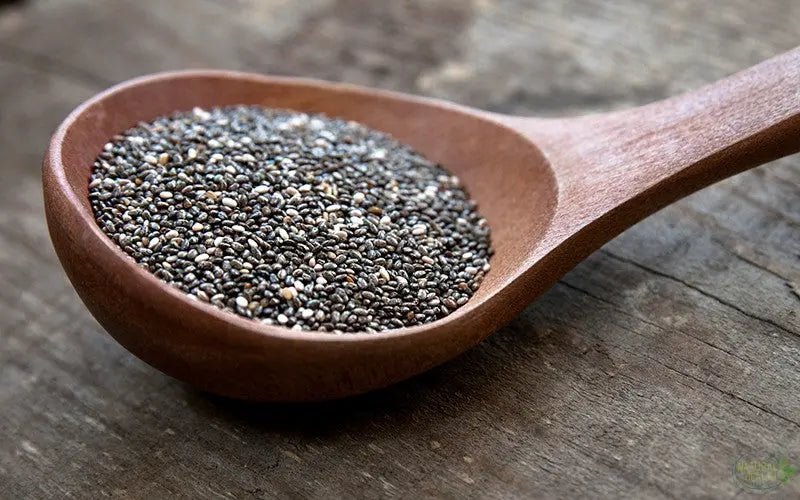
Chia seeds are the edible seeds of Salvia hispanica, a flowering plant in the mint family. They are small — roughly 1 to 2mm — oval in shape, and come in a mix of black, grey, brown and white. The name comes from the ancient Aztec word for oily or fatty, which reflects their composition.
The plant is native to Mexico and Central America, though commercial cultivation has expanded widely. Our chia seeds are sourced from South America, where the crop is now grown extensively across several countries including Bolivia, Argentina and Paraguay.
Where they come from historically
Chia seeds were a significant crop in Mesoamerica long before European contact. They were among the most important agricultural commodities in Aztec society — traded, taxed and used as tribute alongside maize, amaranth and beans. Aztec and Maya records describe chia seeds as a food source for soldiers and runners, valued for their energy density and long shelf life on long journeys.
After the Spanish conquest in the sixteenth century, chia cultivation declined sharply as colonial authorities promoted European crops and suppressed indigenous agriculture. The plant survived in remote areas of Mexico and Central America, where it continued to be grown and used by local communities.
The modern revival began in the 1990s when Argentine agronomists began studying chia as a potential commercial crop. By the mid-2000s it had reached North American and European health food markets and has grown steadily since.
What makes them distinctive
Two qualities set chia seeds apart from most other small seeds.
First, they are exceptionally high in fibre relative to their size — 36g per 100g, with a 28g serving providing around 10g. This is why chia seeds expand so dramatically when soaked — the soluble fibre absorbs liquid and forms a gel, swelling the seeds to several times their original volume.
Second, they are one of the richest plant-based sources of alpha-linolenic acid (ALA), the plant form of omega-3, at 15g per 100g. Unlike flax seeds, the ALA in chia is accessible without grinding — the seeds can be eaten whole and the omega-3 is fully digestible.
What they taste like
Chia seeds are almost entirely neutral in flavour and odour. This is one of the main reasons they have become so widely used — they add texture without changing the flavour of whatever they are added to. Dry, they have a very mild, faintly nutty taste that most people describe as barely noticeable. Soaked, the gel coating has no flavour at all.
Chia in the modern kitchen
The versatility of chia seeds is genuine rather than marketing language. They can be eaten dry, soaked, ground or cooked. They work in sweet and savoury dishes, in baking, in drinks and as a binding agent. Because they are tasteless, they can be added to almost any existing recipe without altering the flavour profile.
For practical preparation ideas, our post on how to eat chia seeds covers everyday uses in detail. For a full breakdown of what they contain nutritionally, our post on chia seed nutritional profile covers the data.
Organic certification
Our organic chia seeds are Soil Association certified organic — grown and handled to the same standard as the rest of our range.
