
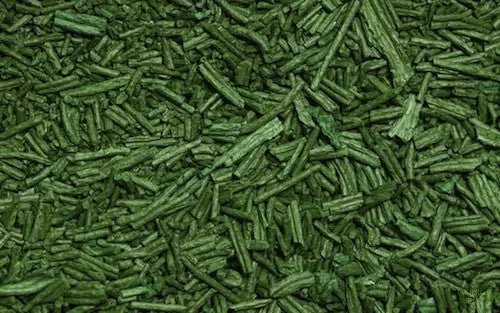
Organic Spirulina: What It Is, What It Contains and How to Use It
Updated:
Spirulina has been cultivated and eaten by humans for a very long time. The Aztecs harvested it from Lake Texcoco in Mexico, and it has been documented as a food source in parts of Central America and Africa for centuries. It fell out of widespread use after the Spanish conquest but attracted renewed research interest in the latter half of the twentieth century, primarily as a high-density protein source and for its notable micronutrient content.
This post covers what spirulina actually is, what it contains, the difference between spirulina types, and how to use it in everyday cooking and supplementation.
What is spirulina?
Spirulina is a cyanobacterium — a type of microscopic blue-green organism that grows in both fresh and salt water. Despite often being called an algae, it is technically a prokaryote: a single-celled organism without a cell nucleus. This distinction matters practically because spirulina has no rigid cell wall, which means its nutrients are more readily digestible than those of true algae like chlorella, which requires the cell wall to be broken down before the contents can be absorbed.
The name comes from the Latin for spiral, reflecting the organism’s characteristic helical shape under a microscope.
What does spirulina contain?
Spirulina’s nutritional profile is genuinely notable. Per 100g of dried powder:
- Protein — around 55–70% by dry weight, making it one of the highest-protein whole foods available. Importantly, it contains all essential amino acids, making it a complete protein source — unusual for a non-animal food.
- B vitamins — B1 (thiamine), B2 (riboflavin), B3 (niacin) and B6 are present in meaningful amounts. Note: spirulina does contain a compound that appears structurally similar to B12, but research indicates this is largely pseudovitamin B12 which the human body cannot use effectively. Spirulina should not be relied upon as a B12 source.
- Iron — spirulina is a rich plant-based source of iron, though the bioavailability varies depending on what else is consumed alongside it.
- Phycocyanin — the blue pigment that gives spirulina its distinctive colour and accounts for around 15–20% of its dry weight. This compound has been the subject of research interest for its antioxidant properties in laboratory settings.
- Beta-carotene, chlorophyll and other carotenoids — present in notable concentrations.
- Essential fatty acids — including gamma-linolenic acid (GLA), though in modest amounts relative to dedicated omega sources.
A typical serving of spirulina powder is 3–5g (roughly one teaspoon), which provides a concentrated hit of the above nutrients in a small volume.
Hawaiian spirulina vs organic spirulina
We stock two distinct spirulina products, which differ in origin and cultivation method.
Hawaiian spirulina is grown in purpose-built open-air ponds on the Kona coast of Hawaii, using pure Pacific Ocean seawater and natural sunlight. The stable, year-round growing conditions and carefully controlled water source produce spirulina with a consistently high phycocyanin content and a clean flavour profile. It is considered by many experts to be among the highest-quality spirulina available.
Organic spirulina is Soil Association certified organic and grown to certified organic standards. For those who prioritise organic certification alongside high protein content, this is a straightforward daily option.
Both are available as tablets and capsules as well as loose powder, all part of our organic supplements range.
Powder, tablets or capsules?
Powder is the most versatile and economical format. It blends easily into smoothies, juices or water and allows precise dosing. The flavour is distinctly ‘green’ and earthy — most people mix it with fruit-forward drinks to balance it. Start with half a teaspoon and build up gradually.
Tablets are compressed spirulina with nothing else added. A practical option for people who want to take a set daily amount without dealing with the flavour. Easy to carry and use consistently.
Capsules are the most convenient format for daily use, particularly for people who want to avoid the taste entirely. Our capsules use a plant-based HPMC shell with no fillers or flowing agents.
How to use spirulina powder
Spirulina powder works best mixed into liquids with strong flavours that balance its earthiness: mango or pineapple smoothies, fresh juice, or blended with banana and plant milk. A teaspoon in a green smoothie is the most common everyday use.
It can also be stirred into hummus, mixed into energy ball recipes alongside oats and nut butter, or added to savoury dishes like soups or dressings — the flavour is less noticeable in strongly seasoned food.
One practical note: spirulina will stain surfaces and clothing a deep blue-green. Work quickly when mixing and rinse equipment immediately.
For a broader look at green whole food supplements and how spirulina compares to wheatgrass, our green superfoods guide covers the comparison.
