
Getting To Know Organic Safflower Tea
Updated:
Organic Safflower Tea
Safflower tea is made from the dried petals of the safflower plant (Carthamus tinctorius) — a thistle-like flowering plant with a cultivation history stretching back over four thousand years. While it remains relatively unknown in the UK, in parts of Asia it is a familiar everyday brew, appreciated for its mild flavour, warm colour, and long association with traditional herbal practice.
About the Safflower Plant
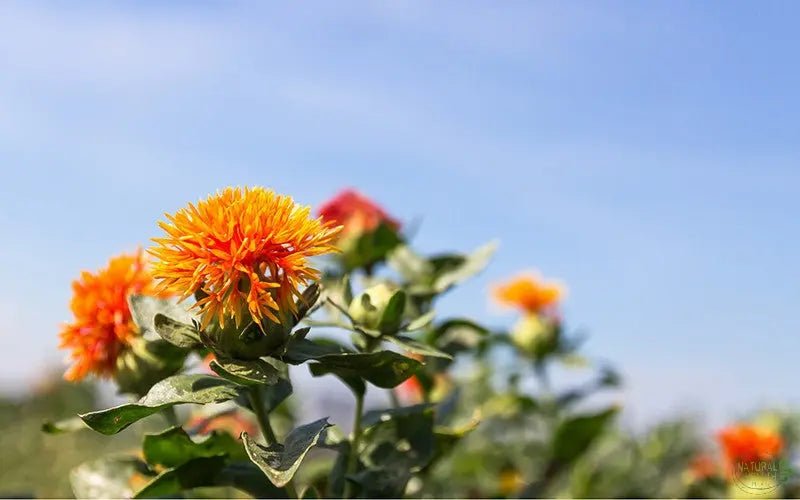
The safflower plant is visually striking — tall, branching, and topped with vivid orange-red flower heads that resemble a thistle in structure. For most of its cultivated history, safflower was valued primarily for its extraordinary colour. The bright yellows and reds produced from its petals made it one of the most prized natural dyes in the ancient world. Garlands made from safflower petals have been found in Egyptian tombs dating to around 3,500 BC, and the dye was used extensively for fabric, cosmetics, and food colouring in cultures across the Middle East, India, and East Asia.
The plant gets its English name via the Portuguese word açafrão, which was used by traders who sold it as a less expensive substitute for saffron — the two plants share a similar colour range though they are botanically unrelated.
Today, safflower is grown commercially across India, Central Asia, Mexico, and the United States. The seeds are pressed to produce safflower oil — high in linoleic acid (an omega-6 fatty acid) and widely used in cooking and food manufacturing. The petals are harvested separately for use in herbal tea.
Safflower in Traditional Herbal Practice
Safflower has a documented history of use in both Traditional Chinese Medicine (TCM) and Ayurveda. In TCM, it is associated with the concept of promoting the smooth movement of blood and Qi, and has been used as a warming, circulatory herb for several centuries. The Chinese name — hong hua (red flower) — reflects its distinctive appearance.
In Ayurvedic practice, safflower has been used as a warming herb and expectorant, traditionally prepared as a tea or decoction. Both traditions have a long history of using the plant in this context, though these are traditional uses rather than clinically verified medical claims.
Safflower Oil
The seeds of the safflower plant yield a pale, flavourless cooking oil that is high in polyunsaturated fat. Safflower oil is used in a range of food products as well as in some cosmetic preparations. It is chemically distinct from the petal-based tea and should not be confused with it.
The Flavour and Aroma of Safflower Tea
Safflower tea has a mild, slightly sweet, faintly floral character. It produces a warm golden-yellow infusion that deepens in colour with longer steeping. The aroma is gentle — less pronounced than chamomile or hibiscus — and the overall drinking experience is calm and approachable. It is one of the more understated herbal infusions and suits those who prefer a quieter, less intense cup.
Precautions
- Pregnant women — safflower has a documented traditional use as an emmenagogue and should be avoided during pregnancy
- People with bleeding disorders or those taking anticoagulant medication
- Anyone planning surgery — avoid safflower products in the weeks prior
Further Reading
For more on how safflower tea is brewed, its flavour profile, and its place in the broader herbal tea tradition, our safflower tea origins and brewing guide covers the detail. Browse our full range of organic herbal teas — all Soil Association certified organic and plastic-free.

3 comments
Safflower is of great benefit to our health we will grow and ,process to reap its benefit while we welcome more research on its benefits and side effect
Safflower grows in the wild in our backyards without us benefiting from it before, thanks for this publication which has introduced us to it’s valuable benefits.
How much safflower petals should we be using in our tea ?